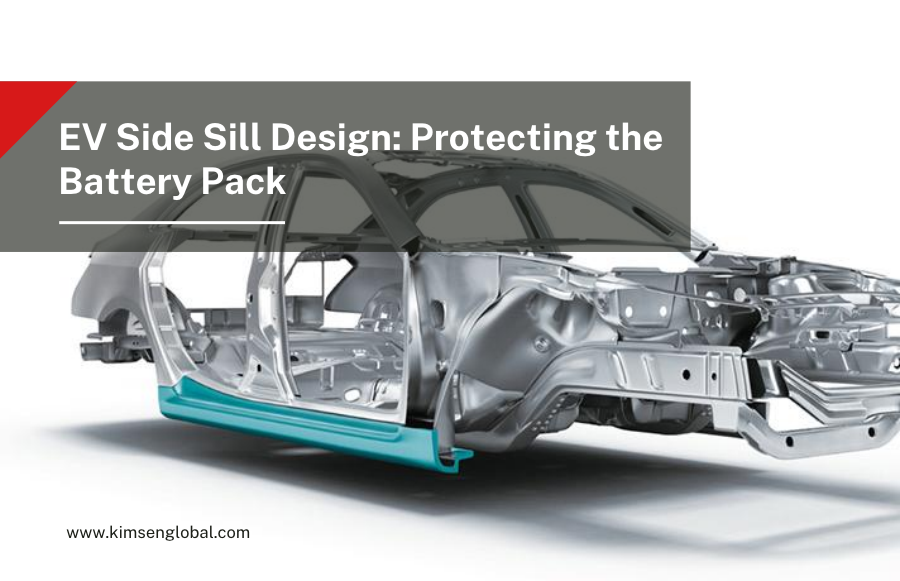
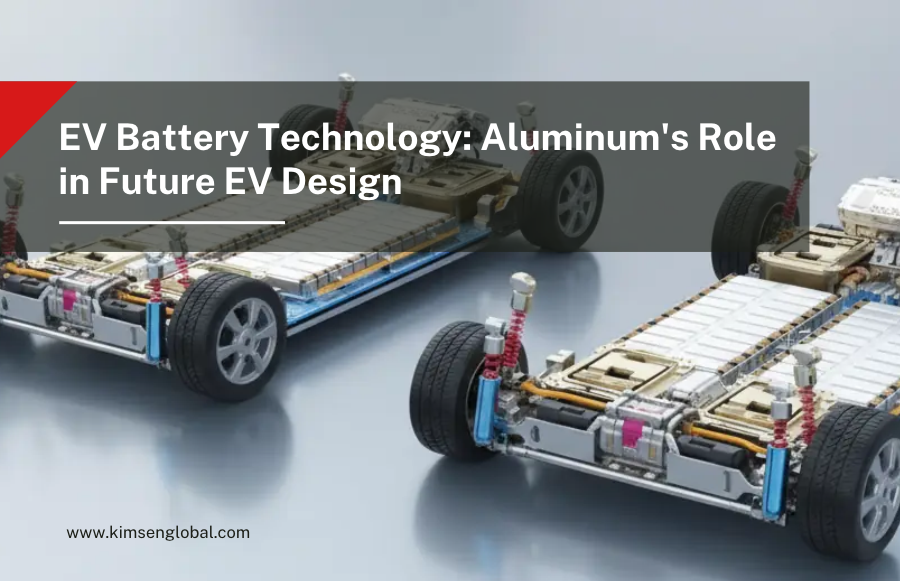
EV side sill design plays a key role in protecting the battery pack during a side collision. Unlike conventional vehicles, electric cars often carry large battery packs beneath the passenger floor, close to the vehicle’s outer structure. This creates a major challenge: engineers must control crash forces within a limited space while keeping the vehicle light and rigid. A well-designed side sill helps absorb impact energy, manage deformation, and reduce the risk of intrusion into the battery enclosure. Materials, cross-sectional geometry, and manufacturing precision all affect how well this protective structure performs.
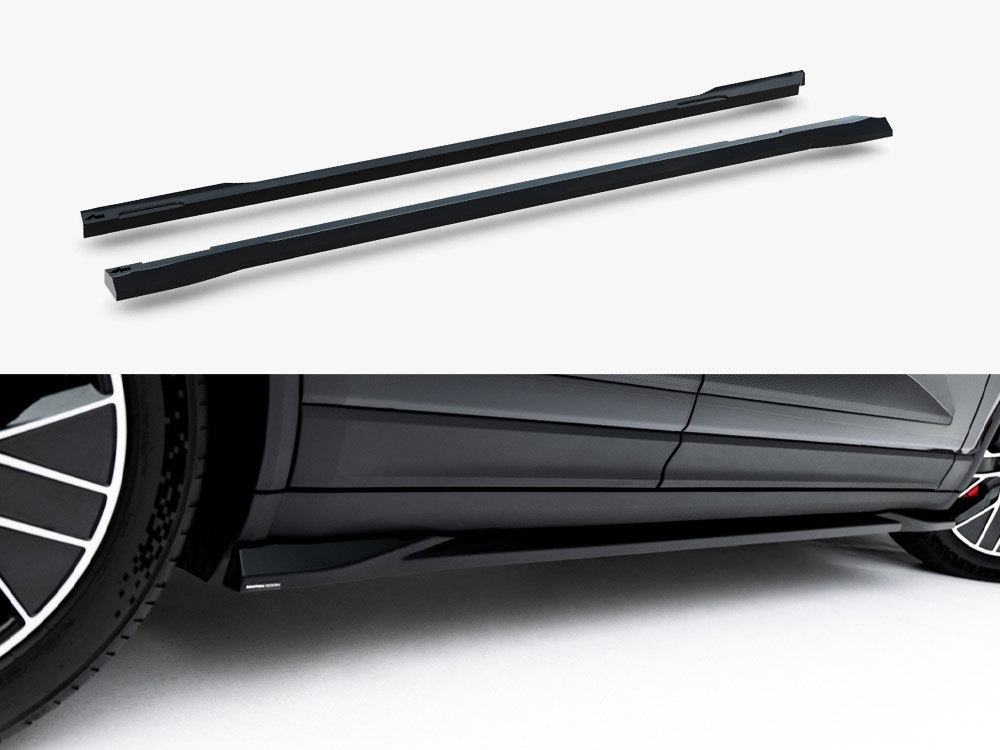
What Is an EV Side Sill?
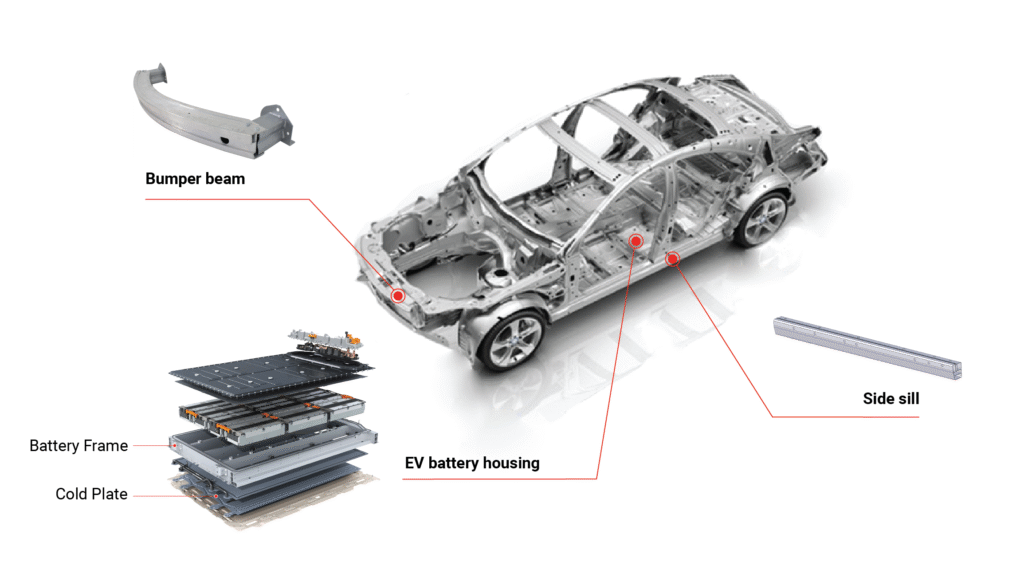
An EV side sill is a structural component that runs along the lower sides of an electric vehicle, beneath the doors. It’s part of the body-in-white structure and helps connect key sections of the vehicle body.
In traditional passenger cars, side sills support body stiffness and passenger protection. Electric vehicles give them another important job: protecting the high-voltage battery pack. Since many EV batteries sit beneath the floor, the side sill forms part of the protective structure between the battery and an external impact. Its main functions include:
-
Absorbing and distributing energy during side collisions.
-
Limiting structural intrusion toward the battery pack.
-
Supporting vehicle body stiffness and structural integrity.
-
Providing mounting and load-transfer paths for nearby components.
-
Contributing to lightweight vehicle design.
However, the side sill doesn’t work alone. Its performance depends on the battery enclosure, crossmembers, floor structure, joints, and other crash-management components.
Why Is Side Sill Design Critical for EV Battery Protection?
Limited space for side-impact energy absorption
In a frontal collision, the vehicle has a relatively long crush zone that can deform and absorb energy. Side impacts are different. The distance between an external obstacle and the EV battery pack can be much shorter. Engineers have less room to manage crash forces before they reach sensitive battery components. This makes EV side sill design especially challenging.
A side sill must provide enough controlled deformation to absorb energy while maintaining a protective distance from the battery enclosure. If the structure is too weak, excessive deformation may occur. If it’s too stiff, high impact loads may transfer to other parts of the vehicle. The goal isn’t simply to create the strongest possible component. It’s to achieve a suitable balance between strength, stiffness, deformation, and energy absorption.
Reducing battery enclosure intrusion
Battery intrusion is a major concern in EV side-impact protection. Severe deformation can damage battery modules, cooling components, electrical connections, or the battery enclosure itself.
Such damage may increase the risk of internal short circuits and thermal runaway, depending on the battery’s condition and safety systems. A properly engineered side sill helps redirect and absorb impact loads before excessive deformation reaches the battery pack. For this reason, engineers evaluate not only the side sill’s strength but also its deformation pattern and interaction with surrounding structures.

Supporting overall vehicle structural integrity
EV battery protection goes beyond the battery enclosure. Side sills also contribute to the vehicle’s bending and torsional stiffness, which influence body performance, durability, and driving characteristics. A side sill with suitable structural rigidity can help the body maintain its intended geometry under normal operating loads.
Key Design Considerations for EV Side Sill Structures
An effective EV side sill must meet several requirements at once. Weight matters, but so do crash behavior, packaging space, and production feasibility.
1. Cross-sectional geometry and multi-chamber design
Cross-sectional geometry has a major influence on side sill performance. Rather than relying on a simple hollow section, engineers may use multi-chamber profiles with internal ribs and reinforcing walls. These features help control how the structure deforms under impact loads.
A multi-chamber aluminum extrusion can offer several design advantages:
-
Internal walls create multiple load-bearing paths.
-
Chamber geometry can influence progressive crushing.
-
Local wall thickness can be adjusted to meet structural needs.
-
Hollow sections can provide stiffness without excessive material weight.
Still, adding more chambers doesn’t always improve crash performance. Poorly positioned ribs may increase mass or produce unwanted deformation patterns. A 2025 study published in the European Journal of Mechanics – A/Solids examined five multi-cell tube configurations for battery protection. Its selected crash-wall design reduced bottom-shell intrusion by 45% in the studied simulation conditions. That result is specific to the research model, not a universal performance figure for EV side sills.
2. Wall thickness and controlled deformation
Wall thickness affects stiffness, mass, and energy absorption. Thicker walls can resist higher loads, but they also add weight and may change how impact energy moves through the vehicle. Thinner walls reduce material use but can buckle too early if the profile isn’t designed carefully. For this reason, EV side sill design often involves adjusting wall thickness alongside chamber geometry.
3. Material selection and mechanical properties
Aluminum alloys are attractive for EV structural components because they combine relatively low density with useful mechanical properties. However, the alloy alone doesn’t determine crashworthiness. Temper, profile geometry, joining methods, and manufacturing quality also matter. For aluminum side sill extrusion, engineers may evaluate 6xxx-series alloys, including 6061 and 6082, depending on project requirements.
Why Aluminum Extrusion Is Used in EV Side Sill Design
Aluminum extrusion gives automotive engineers considerable freedom when developing long structural profiles. During extrusion, a heated aluminum billet passes through a shaped die to produce a profile with a defined cross-section. This process can create hollow chambers, internal ribs, and other features within a continuous structural section. For EV side sills, that design freedom is valuable.
Lightweight structural performance
Aluminum has a density of approximately 2.7 g/cm³, compared with about 7.85 g/cm³ for conventional steel. That makes aluminum roughly one-third as dense as steel. However, a lighter material doesn’t automatically produce a lighter finished component. Aluminum’s lower elastic modulus means engineers may need different wall thicknesses or geometries to achieve the required stiffness.
The potential weight benefit comes from designing the entire structure around the material’s properties.
Complex profiles with fewer separate parts
Extrusion allows engineers to integrate multiple structural features into one profile. Depending on the design, internal ribs and mounting features may reduce the need for separate reinforcing components. This can simplify some assembly operations, although the total production cost depends on tooling, machining, joining, and production volume.
Compatibility with precision machining
After extrusion, side sill components may require cutting, CNC machining, drilling, or other finishing operations. These steps help achieve the dimensions and connection features specified in the vehicle design. For automotive applications, dimensional consistency is particularly important because side sills must interface with other structural components.
Aluminum vs Steel Side Sills: Which Material Is Better?
Aluminum offers low density and flexibility in hollow-profile design. Steel can provide high strength, established forming methods, and attractive cost options. The comparison becomes more meaningful when engineers consider the complete component rather than material properties alone.
| Factor | Aluminum side sill | Steel side sill |
|---|---|---|
| Material density | Lower | Higher |
| Profile design | Well suited to complex extrusions | Well suited to formed and tubular structures |
| Structural stiffness | Requires geometry-specific design | Higher elastic modulus |
| Corrosion behavior | Forms a protective oxide layer | Often requires protective coatings |
| Crash performance | Depends on geometry, alloy, and temper | Depends on grade, geometry, and joining |
| Production cost | Influenced by extrusion, machining, and material | Influenced by grade, forming, and assembly |
Interestingly, aluminum isn’t always the lighter solution at the component level.
A 2026 SAE technical paper by researchers from Hyundai examined a steel tube-in-tube side sill reinforcement. The study reported crash performance comparable to its aluminum reference design, with potential manufacturing and mass benefits for the investigated configuration.
This highlights an important lesson: EV side sill design should focus on the performance of the complete structure, not simply whether aluminum or steel is stronger.
How Engineers Test EV Side Sill Crashworthiness
Before an EV side sill reaches production, engineers need to understand its behavior under realistic crash conditions. Computer-aided engineering (CAE) and physical testing are both important parts of this process.
Finite element analysis
Finite element analysis (FEA) allows engineers to simulate deformation, stress, and energy absorption during impact. Software such as LS-DYNA or Abaqus can support nonlinear crash simulations.
Typical evaluation criteria include battery enclosure intrusion, absorbed energy, peak loads, acceleration, and structural deformation.
Side-impact and pole-impact testing
Side-impact testing helps assess how a vehicle responds when struck by another object. Pole-impact testing presents a particularly demanding condition because the impact force is concentrated over a relatively narrow area. Euro NCAP’s 2026 assessment framework includes side barrier, pole, and far-side evaluations, supported by virtual simulations. These tests evaluate vehicle-level safety. They don’t certify a side sill profile in isolation.
Manufacturing and dimensional inspection
Crash performance also depends on how closely manufactured components match their design specifications. Relevant checks may include dimensional measurement, wall-thickness inspection, mechanical-property testing, and examination of critical joining features. For extruded components, the manufacturer and automotive customer need clear acceptance criteria covering the features that affect assembly and structural performance.
The Role of KIMSEN in Automotive Aluminum Components
For companies sourcing precision aluminum components, manufacturing capability is an important part of supplier evaluation. KIMSEN Industrial Corporation, based in Vietnam, focuses on industrial aluminum extrusion and mechanical processing for technical applications. Its aluminum extrusion and machining capabilities are relevant to the production of custom automotive structural profiles, subject to the required design specifications and manufacturing feasibility.
For EV side sill projects, buyers should assess profile complexity, dimensional tolerances, material requirements, machining needs, and inspection documentation before selecting a manufacturing partner.
Future Trends in EV Side Sill and Battery Protection Design
EV side sill development is closely linked to changes in battery packaging and vehicle architecture. As manufacturers explore cell-to-pack and cell-to-body configurations, battery systems may become more closely integrated with the vehicle structure. This can create new opportunities for weight reduction, but it also places greater demands on structural protection and repair strategies.
Engineers are exploring improved multi-cell geometries, hybrid material structures, and energy-absorbing inserts. The goal is not merely to make the side sill stronger. It’s to manage crash energy while controlling battery deformation and keeping the overall vehicle structure efficient. A 2026 review in Frontiers in Mechanical Engineering emphasizes that localized battery protection requires a combination of load distribution, controlled crushing, deformation limits, and validated safety measures. For aluminum extrusion manufacturers, these developments create opportunities to support increasingly demanding structural designs.
Read more: EV Battery Technology: Aluminum’s Role in Future EV Design – KIMSEN Industrial Corporation