By late August 2026, the aluminum market had stepped back from the edge. Supply is returning. China and Indonesia are shipping more metal. A major Gulf smelter is restarting. The LME price has also retreated from its June peak.
That sounds like relief. It is—just not the kind that immediately lowers every purchase order.
The market has moved from an acute shortage toward a tight, uneven recovery. Futures traders are pricing the improvement early. Physical buyers, meanwhile, still face scarce non-sanctioned inventory, elevated regional premiums, trade costs and a slow rebuild of working stock. For companies buying extruded or CNC-machined aluminum parts, the gap matters more than the headline LME move.
Market note: The following analysis represents KIMSEN’s interpretation of market data available as of August 24, 2026. It is not a specific aluminum price forecast. Reported figures are sourced, while future market developments remain uncertain.
The shortage has eased—relative to a much worse scenario
The strongest evidence comes from the market balance. On August 4, Wood Mackenzie cut its estimate for the 2026 global aluminum deficit to approximately 900,000 metric tons. At the height of the Middle East disruption, the expected shortfall was between 2.5 million and 3 million tons. That is a major improvement, but a 900,000-ton deficit is still a deficit—not a comfortable surplus.
Three supply channels have reduced the immediate pressure.
First, Emirates Global Aluminium is restoring production at Al Taweelah. By August 11, EGA had restarted 227 of 1,262 reduction cells, or approximately 18%. However, the company expects hot-metal output to return to pre-incident levels only in the first quarter of 2027. Its aluminum sales in the first half of 2026 were 32% below the same period last year. Recovery is real, but it is being measured in quarters—not weeks.
Second, China has become a swing supplier. Chinese exports of semi-finished aluminum increased 18% year on year to 3.2 million tons in the first half of 2026, while alloy exports nearly doubled to 238,500 tons. Primary aluminum output grew 2.2% as domestic demand remained soft.
Third, Indonesia is sending more primary metal into international trade. Its aluminum exports increased 58% year on year during the first five months of 2026, after more than tripling between 2024 and 2025.
There is a catch. Chinese bars, rods, tubes and other semi-finished products cannot replace every lost ton of primary aluminum or every billet specification. Alloy, temper, origin rules, anti-dumping measures and customer approvals all limit substitution. More aluminum on the global market does not necessarily mean that the correct material is available to every manufacturing plant.
The LME screen is calmer. Physical metal is not.
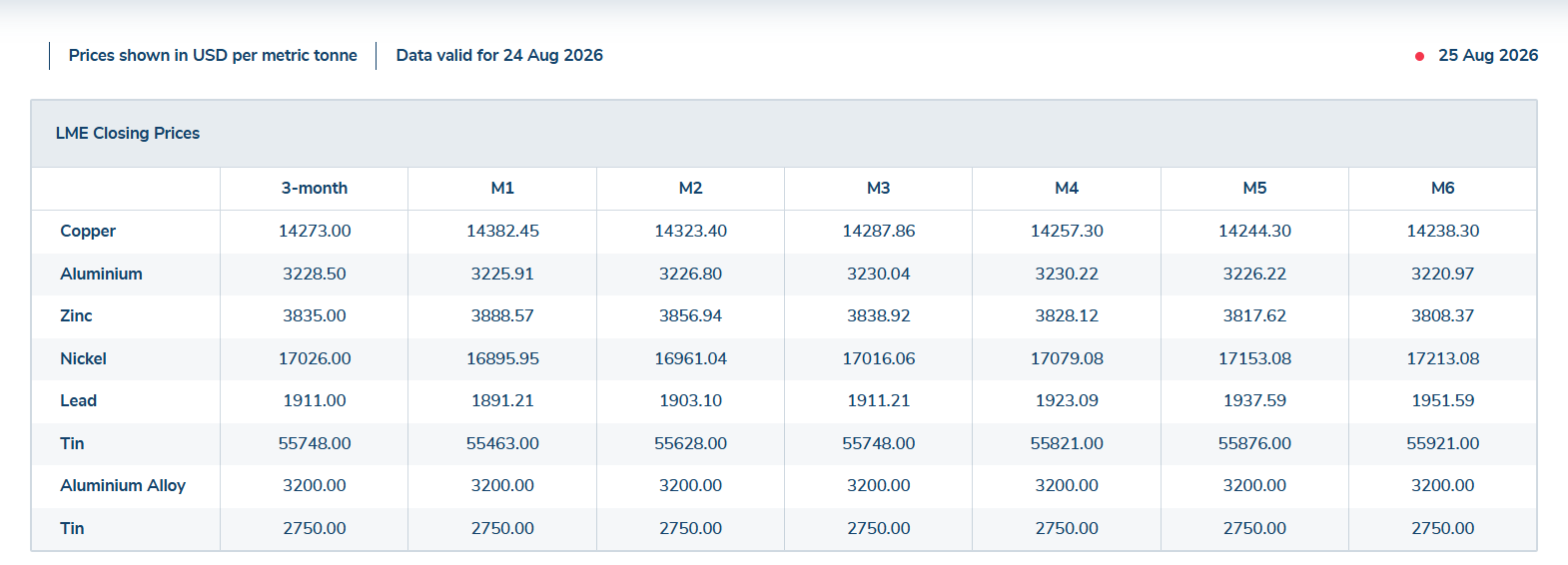
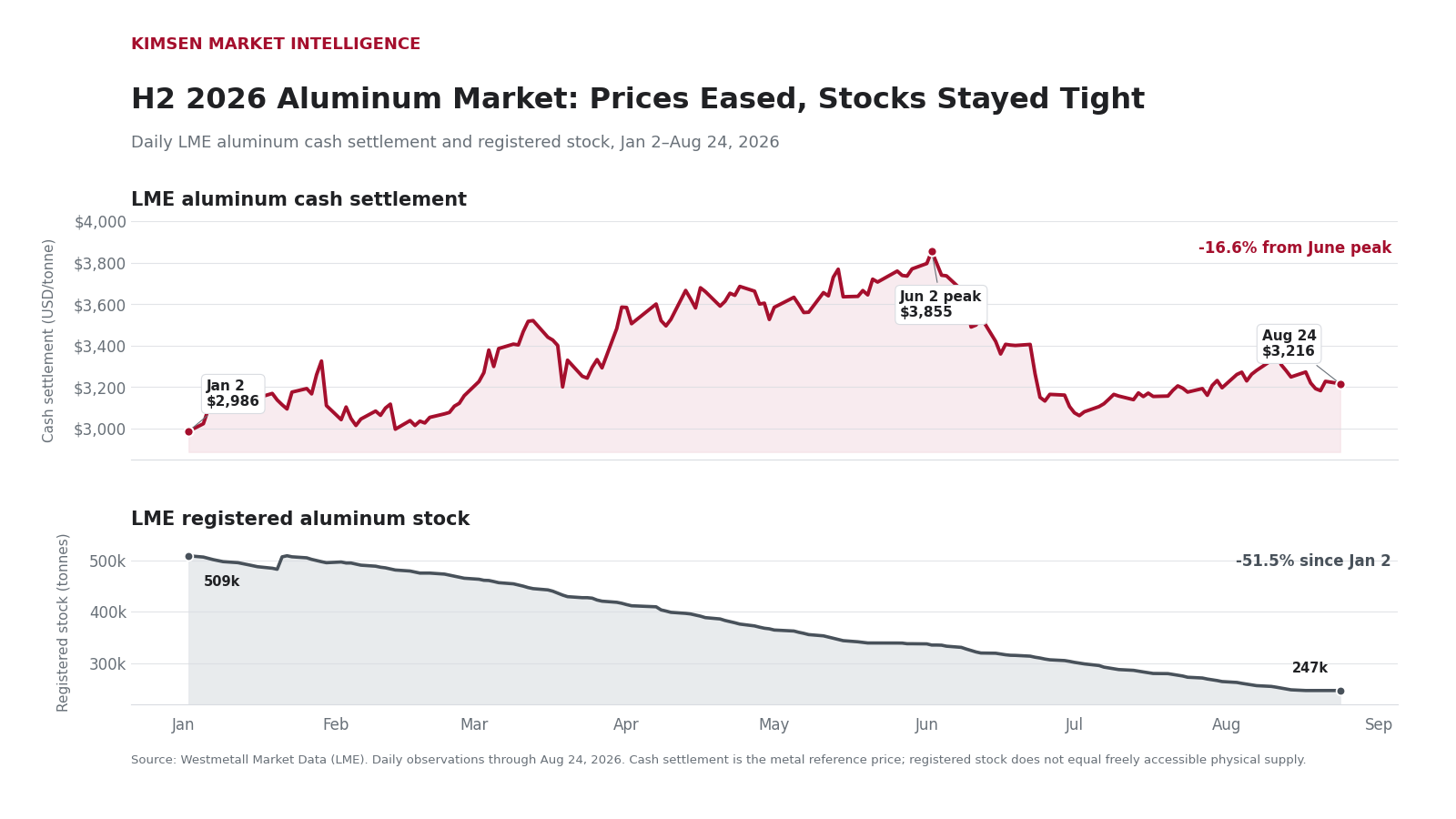
LME three-month aluminum fell from a four-year high of $3,787.50 per ton in early June to approximately $3,270 on August 18. Much of the geopolitical premium disappeared from the futures price.
But exchange inventory, however, sends a less comfortable signal. LME-registered aluminum stocks had halved since the beginning of 2026 to approximately 250,000 tons by mid-August—the lowest level since 1990. At the end of July, Russian-origin aluminum represented 95% of the 245,250 tons available on warrant. US and European buyers cannot freely use much of that stock, while many Asian buyers prefer to avoid it. The headline inventory figure therefore overstates the amount of aluminum that Western manufacturers can realistically access.
Regional premiums show the same gap between financial calm and physical stress. EGA reported that aluminum premiums during the first half of 2026 averaged approximately $2,405 per ton in the US, $413 per ton in Europe and $282 per ton in Japan—well above their first-half 2025 averages. Japan’s Q3 premium subsequently settled at $395 per ton, an increase of 11.9–12.9% from Q2 and the highest quarterly level in a decade.
In plain terms, the commodity reference price fell faster than the cost of getting usable aluminum to the buyer.
Trade policy is now part of the metal cost
For US buyers, Section 232 is too significant to leave outside the quotation model. Under the June 2026 tariff framework, certain aluminum products carry a 50% additional duty, while many derivative products carry a 25% duty. Selected equipment categories receive different temporary treatment. The exact exposure depends on the HTS classification, product scope, origin and aluminum content.
For EU buyers, the Carbon Border Adjustment Mechanism entered its definitive regime on January 1, 2026. Importers above the 50-ton threshold must become authorized CBAM declarants, report embedded emissions and surrender certificates linked to EU Emissions Trading System prices. The first declaration and certificate surrender covering 2026 imports will be due by September 30, 2027. This means that supplier emissions data must be collected well before the filing date.
These policies change sourcing calculations. A low factory price can lose its advantage after duties, carbon costs, documentation work and freight are added. Buyers comparing suppliers in Vietnam, China, Europe and domestic markets should compare landed, compliant cost—not EXW price alone.
Why finished aluminum parts remain expensive
Here is the manufacturing reality: a machined aluminum part is not an LME contract with holes drilled into it.
The LME price is only the metal reference. A finished-part quotation can also include regional premium, alloying, billet conversion, extrusion yield, cutting, CNC cycle time, fixtures, surface treatment, inspection, packaging and freight. These inputs reset on different schedules.
Material may be linked to a 30-day LME average. Billet can be bought before the quote date. Anodizing depends on batch size and specification. CNC cost follows machine time, tool wear and tolerance—not the daily metal price. Tight flatness, cosmetic surfaces, leak testing or full traceability may add cost even when aluminum itself gets cheaper.
That is why a 10% move in LME rarely becomes a 10% move in the finished part. For a clearer breakdown, see KIMSEN’s Aluminum Price Guide: How LME, Premiums and Processing Costs Affect Buyers.
Demand is not booming. It is rotating.
The current pressure is mainly a supply and availability story, not a broad demand boom. Chinese end-use demand was broadly flat in H1. In the US, industry leaders expect total extrusion demand to grow only 0–1.5% in 2026, while data-center-related aluminum demand is performing better and some EV-related demand has weakened.
Europe offers another nuance. The eurozone manufacturing PMI rose to 52.8 in August, its highest in more than four years, while new export orders expanded for the first time since early 2022. That is supportive for industrial demand, though business confidence remains cautious.
So demand is not strong everywhere, nor is it collapsing everywhere. Thermal management, power infrastructure and data centers are holding up better than some traditional construction and EV programs. Suppliers with the right machining, finishing and testing capacity can remain busy even when headline extrusion growth looks weak.
What buyers should do in H2 2026
The answer is not to panic-buy. It is to price risk more clearly.
- Separate material adjustment from processing cost. State the LME reference, averaging period, regional premium and re-pricing trigger in the quotation.
- Compare landed cost by HTS code and destination. For US imports, model Section 232 exposure before approving a source. For EU imports, request CBAM-ready emissions data early.
- Give suppliers a quarterly forecast. Purchase orders may remain monthly, but greater visibility helps suppliers secure billet, reserve machining capacity and reduce urgent freight.
- Approve technical alternatives before a shortage occurs. Review equivalent alloys, tempers, billet sources and surface-finish limits with engineering—not during an overdue shipment.
- Track premiums and availability, not LME alone. A lower screen price offers little comfort if the required alloy, temper or origin is unavailable within the delivery window.
KIMSEN’s H2 2026 view
The worst shortage scenario has receded, but the market has not rebuilt a safety cushion. If Gulf restarts continue and Chinese and Indonesian exports stay strong, LME aluminum may remain below its June peak. Yet low accessible inventories, high regional premiums and new trade costs can keep the delivered price of finished components firm.
For buyers, the practical conclusion is simple: expect less panic, not cheap aluminum.
KIMSEN Industrial Corporation approaches aluminum quotations from the finished-part level—extrusion, CNC machining, surface treatment, assembly and testing—not from LME alone. In H2 2026, that full cost view is the more reliable way to compare suppliers and protect a production schedule.
Reference:
Sources were accessed on August 24, 2026. Market prices and premiums should be checked again if publication is delayed.
2026 global deficit revised to ~900,000 tons from 2.5–3 million tons. Wood Mackenzie, “Metals sector weathers Middle East shock…,” August 4, 2026. Open source
EGA restart, sales, production, premium averages and Q1 2027 recovery target. Emirates Global Aluminium, “EGA delivers resilient H1 2026 performance…,” August 12, 2026. Open source
China H1 production, demand and export flows; August LME price. Andy Home, Reuters, “China eases Iran war aluminium shock, but at a cost,” August 18, 2026. Open source
Indonesia export growth and June-to-July price retreat. Andy Home, Reuters, “War? What war? Aluminium’s Gulf disruption premium vanishes,” July 24/28, 2026. Open source
LME inventories at 36-year low and July stock composition. Andy Home, Reuters, “Aluminium on thin ice as LME stocks hit 36-year low,” August 13/14, 2026. Open source
Japan Q3 premium and regional premium movements. Yuxi Du, S&P Global Energy, “Japanese Q3 aluminum premium settles higher at $395/mt CIF Japan,” July 6, 2026. Open source
US Section 232 framework current June 2026. The White House, Presidential Proclamation, June 1, 2026. Open source
EU CBAM definitive-regime obligations. European Commission, Taxation and Customs Union, accessed August 24, 2026. Open source
First CBAM declaration and surrender date for 2026 imports. European Commission, “CBAM communication and news,” June 23, 2026 update. Open source
US extrusion and sector-demand outlook. Anthony Rizkala, S&P Global, February 4, 2026. Open source
Eurozone August manufacturing and export-order signals. Indradip Ghosh, Reuters, August 21, 2026. Open source
Current IAI production dataset spot-check. International Aluminium Institute, “Primary Aluminium Production,” July 2026 issue, accessed August 24, 2026. Open source